
Quality Process Solutions
Coal Preparation and Mineral Processing Solutions
Density Tracers
Dense Medium Separator Performance Monitoring
Performance of dense medium separation devices (Dense Medium Cyclones or Dense Medium Baths) is measured through several Key Performance Indicators (KPIs), including:
- Cutpoint (RD50);
- Sharpness of separation (Ep75-25 and Ep90-10);
- Dense Medium Cyclones (DMC);
- SWMS (Safe Work Method Statement); and
- JSA (Job Safety Analysis).
These KPIs are generally developed from analysis of sample data during expensive plant audit campaigns, from one-off sample runs, or tracer tests to give partition curves as shown below. The KPIs are calculated using one of many possible partition curve models.
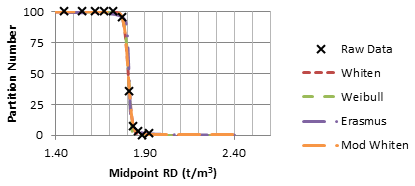
Analysis of the partition curve can identify a myriad of possible performance inefficiencies.
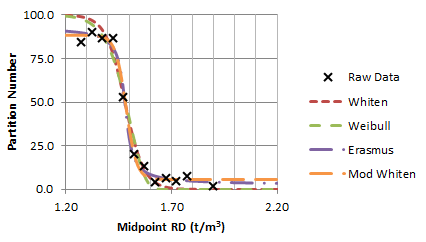
The ‘tail’ on the product and reject, a relatively shallow sloping curve (ie high Ep) indicates a high amount of misplaced material and poor performance. The result is a significant loss in yield and contamination of the product.
Implications
Dense Medium Separators are generally the major beneficiation units in a CHPP; often processing more than 80% of the plant feed. Consequently, even small losses in efficiency can have significant implications for production.
For example, for a 1000 t/h plant with 800 t/h of feed reporting to the DMC, a 1% increase in material misplaced to reject will result in a loss of 8 t/h of product coal. At an assumed sale price of $100/t, this translates to a nominal $5.6million per year of lost revenue for a plant operating at 7000 hrs per annum.
This yield loss could be attributed to a number of factors, such as:
- Spigot wear;
- Vortex finder overloading;
- Low medium to coal ratios;
- Feed pressure issues; and
- Surging.
Regular dense medium performance testing will identify any performance deficiencies allowing for timely rectification of the problem.
QPS engineers will interpret the test results to help identify and rectify the root cause of the problem.
Density Tracer Testwork Advantages
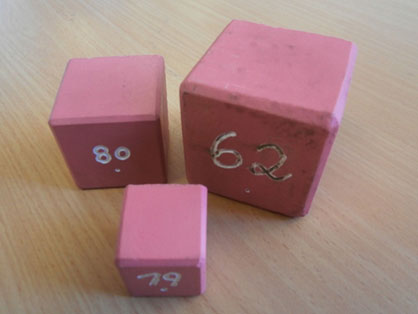
Density tracers are used to test the performance of coarse coal density separation devices such as Dense Medium Cyclones and Dense Medium Baths. They have significant advantages over more traditional sampling and float-sink testwork in that they:
- Reduce effects from sampling bias or error in sample collection;
- Are lower cost than equivalent float/sink tests and so allow for a higher number and more detailed tests to be performed for the same price;
- Allow better resolution around the cut-point of the separator, as the density intervals are set at smaller increments; and
- Eliminate minimum sample mass constraints that cause significant error in coarse coal float-sink testwork.
QPS Services
QPS will provide the necessary equipment such as tracers and tracer retrieval equipment, as well as technical personnel for the tests. Upon completion, completed SWMS/JSAs and analysis and interpretation of the results will also be provided. The tests are typically conducted over a single day per feed type. The final report will include the partition curves for all tests performed, the KPIs for the separator(s) and an analysis of any issues highlighted by the test work.
Regular tracer test work performed by QPS provides the advantage of tracking relative performance between tests, and consequently of developing a baseline to identify performance changes over a given period.